Article: Interior Design Trends 2026: Warmth, Restraint and the Art of Considered Living
Interior Design Trends 2026: Warmth, Restraint and the Art of Considered Living
The most enduring interiors are never entirely of their moment. They absorb influence without chasing it, taking what is relevant and discarding what is merely fashionable. Here is what is shaping truly elegant living spaces in 2026, and how to apply it with confidence.
A Note on Trends
The word 'trend' is often misused in interior design. It suggests something temporary, a colour to be adopted and discarded within a season, a silhouette to replace itself in eighteen months.
The influences worth paying attention to are slower and deeper than that. They reflect genuine shifts in how people want to live: more quietly, more intentionally, with greater emphasis on quality and longevity.
What follows are not passing fashions. They are directional shifts that will shape beautiful interiors well beyond 2026.
Warm, Grounded Neutrals Are Replacing Cool Minimalism
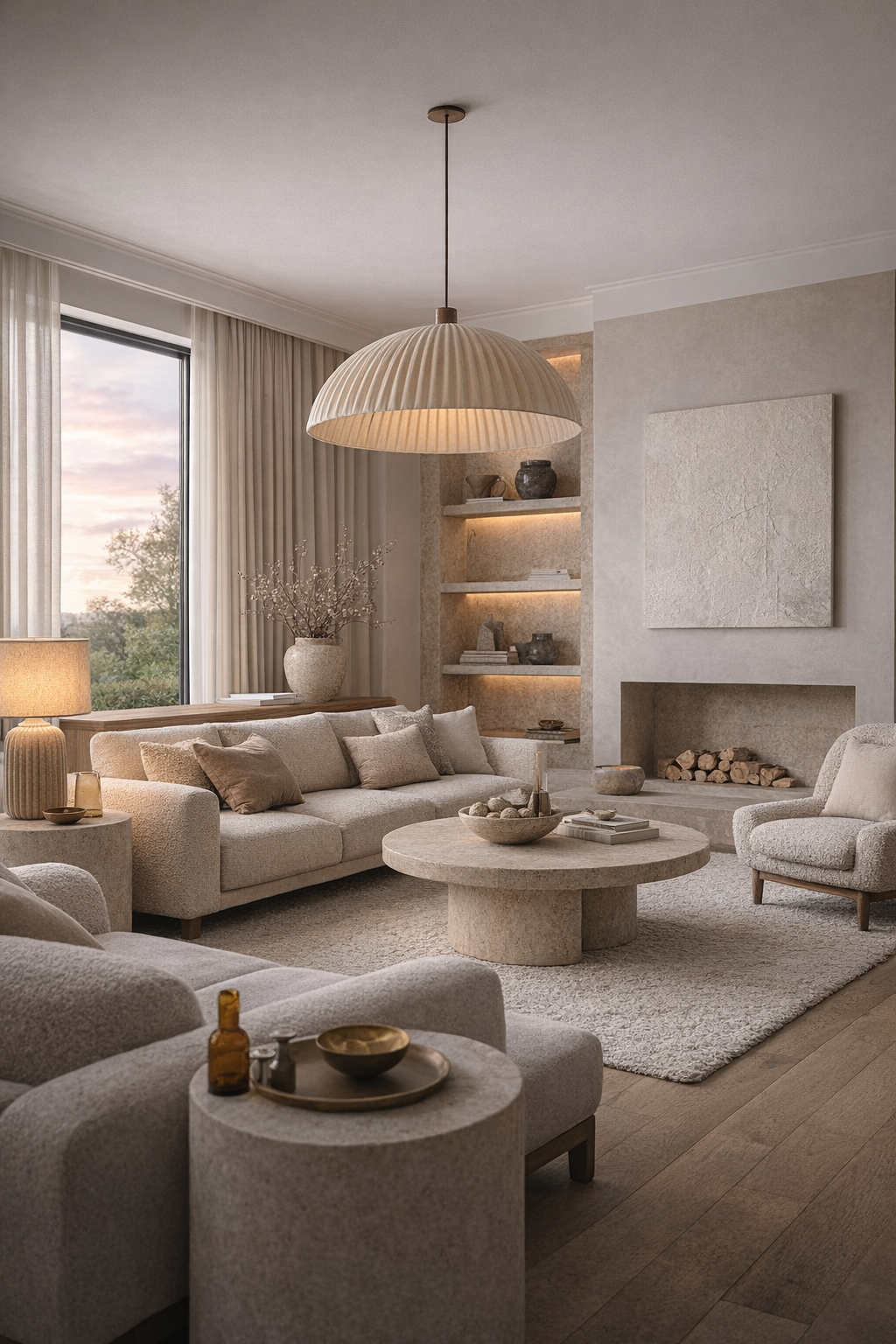
The cool grey palette that dominated interiors for much of the past decade is giving way to something warmer and more nuanced. Stone, taupe, clay, parchment and soft ivory are emerging as the defining tones of refined living spaces, and the shift is significant.
These hues do something cool greys rarely achieved: they make a room feel inhabited. They suggest comfort, maturity and a home that has been thoughtfully accumulated rather than rapidly assembled.
The skill lies in layering within the same tonal family. A room furnished in ivory, cream, sand and warm white avoids the flatness of a single-colour scheme while maintaining a sense of visual calm. Introduce grain, in wood, weave and stone, to add dimension without colour.
How to Apply It
If repainting is not immediately on the agenda, introduce warm neutrals through upholstery and soft furnishings first. A stone-toned bouclé armchair against a greyed wall will begin to shift the feeling of a room considerably. Layering comes before commitment.
Sculptural Furniture: Fewer Pieces, More Presence
One of the most important, and counter-intuitive, trends in luxury interior design is the move away from filling rooms. The instinct to add more, to cover every corner and surface, is being replaced by something more considered: the selection of fewer, better pieces, chosen for their intrinsic quality and visual power.
Curved sofas with deep, generous proportions. Rounded armchairs that hold their shape over years of use. Coffee tables with architectural bases that read as sculpture from across the room. These pieces do not merely furnish a space, they define its character.
This is the principle of furniture as investment. A sofa bought for its silhouette and its materials, rather than its price point, does not need to be replaced. It becomes part of the home.
The Case for Negative Space
Restraint is the harder discipline in interior design. But a room with breathing room, a generous sofa, a single side table, a considered lamp, communicates confidence. It signals that every piece has earned its place. That is the feeling that characterises genuinely luxurious interiors.
The instinct to fill every corner is being replaced by something more considered: the selection of fewer, better pieces, chosen for their intrinsic quality and visual power.
Texture Is the New Colour
In 2026, the most sophisticated interiors are built not around colour contrast but around textural richness. This is a more demanding approach, it requires a sharper eye, but the results are subtler and more enduring.
Consider the difference between a room furnished in various shades of cream with varied textures, a linen sofa, a wool rug, a brushed brass lamp, a smooth marble coffee table, and the same room with all surfaces in identical finishes. The former feels alive. The latter, however expensive, feels flat.
The materials defining this textural moment are:
- Bouclé: looped and tactile, adding warmth and visual softness to seating
- Natural linen: relaxed, breathable and deeply honest in its texture
- Brushed and antiqued metals: brass, bronze and blackened steel in matte rather than polished finishes
- Natural wood with visible grain: oak, walnut and ash, chosen for character rather than uniformity
- Woven accents: in rugs, cushions and throws, introducing organic rhythm to flat surfaces
Combining smooth and textured finishes in the same room, a polished plaster wall beside a woven throw, a marble surface beside a linen cushion, creates sensory interest without relying on pattern or bold colour.
The Indoor-Outdoor Continuum
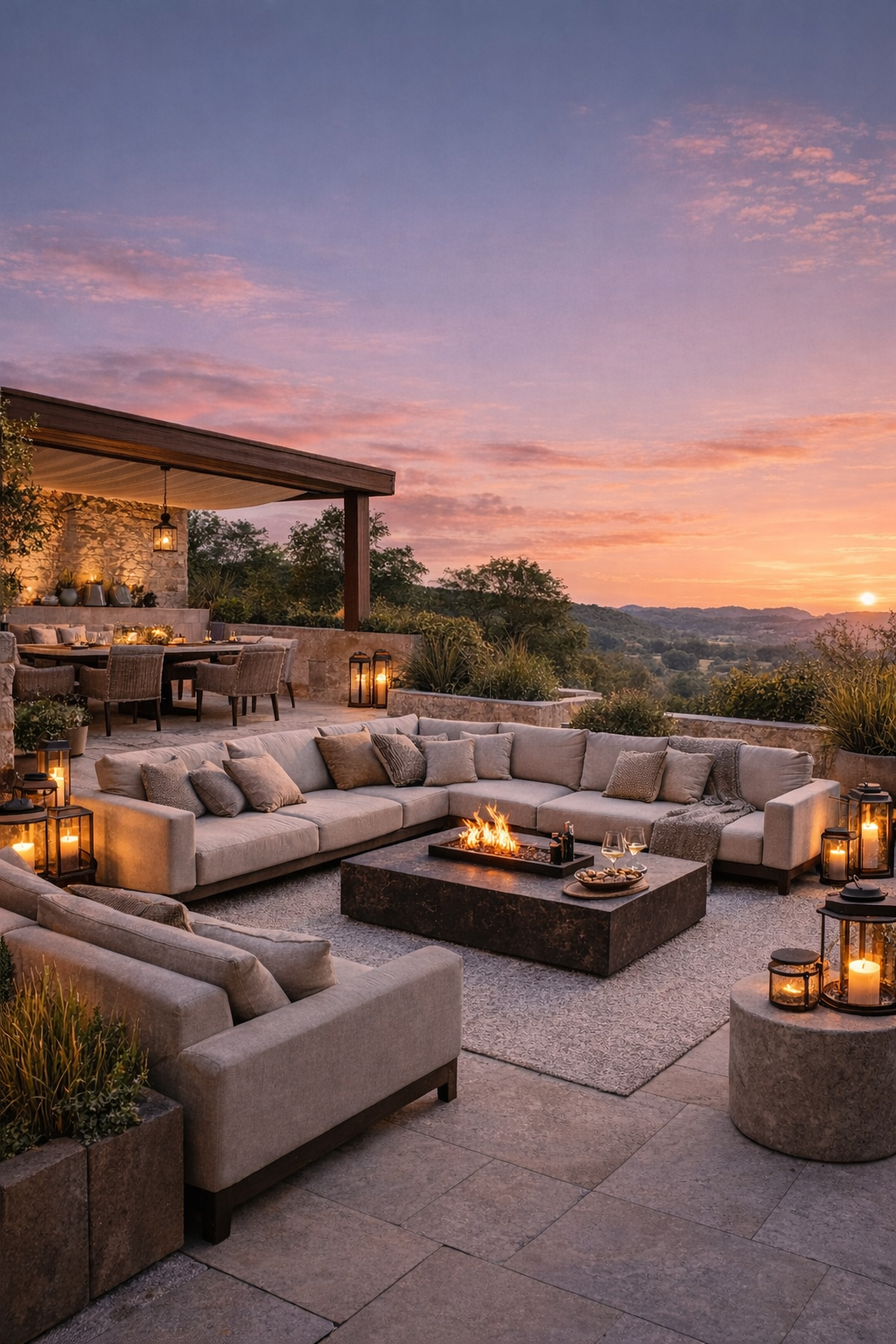
The boundary between interior and exterior continues to dissolve, and this is one of the more significant shifts in how high-end homes are being conceived and furnished.
Natural materials such as teak and stone are migrating from garden to living room. Furniture collections are increasingly designed as a continuum, with pieces that sit as comfortably indoors as out. Large glazed doors and floor-to-ceiling windows allow external light and planting to become active design elements within interior spaces.
For those furnishing a home with this in mind, the key is material consistency. If your interior features oak and linen, allow those tones to inform your outdoor furniture choice. If your terrace features stone paving, let it find an echo inside. The result is a home that feels unified, and, in well-designed spaces, considerably larger than it actually is.
Statement Lighting: The Detail That Changes Everything
Lighting is the most under-appreciated element in interior design, and the one that, when addressed properly, transforms a space more dramatically than almost any other intervention.
The trend in 2026 is toward lighting that holds its own as an object, not merely as a source of illumination. An oversized floor lamp with a sculptural base. A cluster of pendants at varying heights over a dining table. A pair of considered wall lights that frame a sofa in the way a good painting frames itself.
The Principle of Layered Lighting
The defining characteristic of sophisticated lighting design is layering: multiple sources at different heights, each independently controllable, creating the ability to shift the mood of a room entirely without changing a single piece of furniture.
Ambient lighting provides the base level. Task lighting, a reading lamp, an angled light above a desk, serves function. Accent lighting, directed at a piece of art or a shelf of objects, creates drama. Together, they give a room genuine atmosphere.
Warm-toned bulbs, 2700K to 3000K, are universally flattering and essential in living spaces intended to feel intimate and comfortable.
Investing in Endurance
Perhaps the most significant shift in luxury interior design right now is not aesthetic but philosophical. The era of the fast interior, the room refreshed every three years with a new coat of paint and a sofa from a new collection, is fading.
In its place is a returning appreciation for the crafted object: the piece designed to be passed on rather than replaced, bought for the quality of its making rather than the immediacy of its appeal.
This means asking different questions when furnishing a home. Not 'do I like this?' but 'will I still like this in fifteen years?' Not 'is this affordable?' but 'is this worth it?' The answers lead to better rooms, and to homes that improve with age.
The most enduring interiors absorb influence without chasing it. They take what is relevant and discard what is merely fashionable.
The result of these converging influences, warmth, restraint, texture, quality, is a form of interior design that feels quietly confident. Not showy, not spartan. Simply considered. That is the standard worth aiming for.
→ Explore Lux Living's indoor collection at luxliving.uk — sophisticated furniture and décor for refined living spaces.